
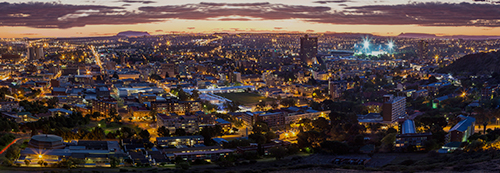


When most South Africans think about Bloemfontein, the idea of a “small town somewhere in the Free State” comes to mind. Those who have visited the city of roses might recall Bloem as a place full of friendly people or a destination with rather extreme temperatures. But few (including the majority of its residents) know about the interesting historical facts that the city has to offer:
1.) Founded in 1846 as a fort by British Major H. Douglas Warden, the word “Bloemfontein” means “fountain of flowers” (Dutch). The city is famous for its annual rose festival which attracts thousands of visitors each year.
2.) In 1910 Bloemfontein became the Judicial Capital of the Union of South Africaand today still serves this purpose. It houses the Supreme Court of Appeal (Corner of President Brand St & Elizabeth St) which is regarded as the second highest court in South Africa.
3.) Grey College, which is known as one of the best schools in Africa, opened its doors on the 17th of January 1859 in Bloemfontein. Famous for producing a very long list of Springbok rugby players (including the likes of Coenie Oosthuizen, Bismarck Du Plessis, Heinrich Brussow, Frans Steyn, Ruben Kruger etc.), this prestigious school also boasts with old greys like Hansie Cronje, Wayde Van Niekerk and Bram Fischer (anti-apartheid activist that defended Nelson Mandela in the Rivonia Trial).
4.) Two giant political parties that played a critical role in the history of South Africa were both formed in Bloemfontein. The African National Congress (ANC), who is the ruling party at present, was birthed in 1912 in ‘Waaihoek’ – Bloemfontein’s first African township. The other political party, the National Party (NP), was formed in 1914.
5.) The famous author, JRR Tolkien, who wrote ‘The Hobbit’ and ‘The Lord of the Rings’ was born in Bloemfontein on the 3rd of January 1892. The Tolkien family left South Africa when Tolkien was only three years old.
6.) During the Anglo-Boer war (11 October 1899 to 31 May 1902) there was a concentration camp in Bloemfontein where approximately 1700 people perished (www.angloboerwar.com) . In remembrance of the 26 000 (mostly) woman and children that died in concentration camps, the National Women’s Memorial was built in Bloemfontein.


